Can we have (1) consensus that we have no desire for pyrrhic victories nor strategic losses? Sure, our military really hammered Iran. “Winning” a war but suffering substantial strategic losses is a classic Pyrrhic victory. Keep in mind that the Iran War was never about two choices: going to full war against Iran or allowing Iran to have a nuke. It was about how best to prevent Iran from getting a nuke over the long term. A delay of a few years is meaningless.
To date, the Pentagon has admitted that 18 service members were killed and 756 wounded. Presidents must always place a high value on the loss of American lives when they choose to initiate a war. Do we have (2) consensus that we want our leaders to be good stewards of the lives of our military personnel? Our war has cost 2,500 innocent civilians, including some 200 at a school for little girls, and countless wounded. Can we have (3) consensus that killing these innocent people—mainly women and children—is a very heavy price to have to pay, especially when one of the key objectives of the war was to help the Iranian people?
We have lost the use of about 15 military bases, damaged to the point that they are useless. The importance of that is hard to overstate. The reason the USS Abraham Lincoln was unable to be adequately resupplied was due to destroyed logistics hubs in the region. Can we (4) agree that an extended deployment of some 260 days without a port call is a huge cost in morale, especially when the Commander in Chief says it’s not long enough?
We have also depleted some of our most powerful and expensive munitions, leaving strategic assets vulnerable. (5) Not good, right?
The Strait of Hormuz. Prior to this conflict, passage through the strait was free and unrestricted. Oman, once a close U.S. partner, has now moved toward cooperation with Iran to jointly manage the Strait of Hormuz—including control of shipping routes and potentially the revenues from the waterway. The closing of the Strait has cost Americans over $100 billion in added fuel costs, plus over $100 billion in direct military costs. And another cost: the strategic oil reserves are at 41% of capacity, the lowest they have been since 1977. Can we have (6) consensus that the closing of the Strait, the loss of Oman, and the low oil reserves are all very heavy prices to pay?
And then there is our reputation and stature in the world. Before the war, Iran’s military was ranked 16th in the world. Due to the war, they are much weaker, and yet the greatest military power in the history of the world is incapable of opening the Strait. Can we have (7) consensus that this is an embarrassment and that it is not making America great?
Allies. In the eight major wars the U.S. has been in over a century, we have always had allies. Other than Israel, we not only had no allies, despite America’s demand that our allies come help us, and despite our loud threats to them, they all refused. (8) Can we not agree that the cost of diminishing our relationship with our defense and economic allies and propelling them toward a closer relationship with China is a huge cost to pay and one that will take years, if ever, to repay? And that this America First policy has resulted in America alone. As such, the Administration has been browbeating Congress to add $500 billion annually to the defense, we mean war, budget. Are we not all concerned about huge deficit spending? Can we have consensus that going alone without allies at $500 billion is an incredibly high, if not totally unacceptable, price to pay?
We feel we made a solid case with the prior essay that the benefits derived from delaying Iran’s nuke program a couple of years are insignificant. In 2017, we had five uber-powerful allies ensuring Iran did not have highly enriched uranium (HEU) and, unlike now, the IAEA had direct access to the nuclear facilities. Iran was in full compliance with the JCPOA—they had 0 HEU, and today they have half a ton.
Can we have (9) consensus that where we are now compared to where we were in 2017, now is much worse?
Can we have (10) consensus that even those we have defeated Iran, it is no more than a Pyrrhic Victory?
To return to David’s Facebook page and make comments select: https://www.facebook.com/David.Treppendahl
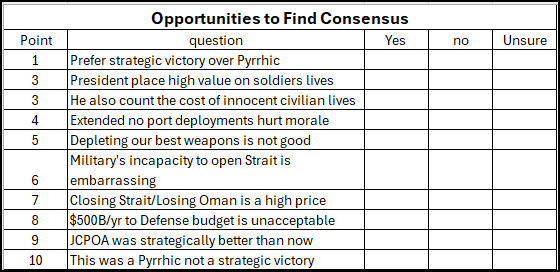
If you are on the Red or Purple Team, note any points you have consensus. E.g. “Yes on #3 and #7”
These are potential points for consensus:
To return to this blog’s homepage and choose another discourse, select: Finding Consensus